Recently, Live Science published a chart showing that the US spends about one-fifth of its budget on the military. But this aggregate view hides how Congress prioritizes spending, when you consider what is discretionary and voted upon each year. A more salient view of these figures segregates discretionary spending from mandatory spending. During the severe economic downturn of the past two years, how has Congress prioritized spending? When it comes to discretionary spending, Congress gives 58% to the military. Here are US budget charts for the years 2009 and 2010, according to the National Priorities Project (NPP):
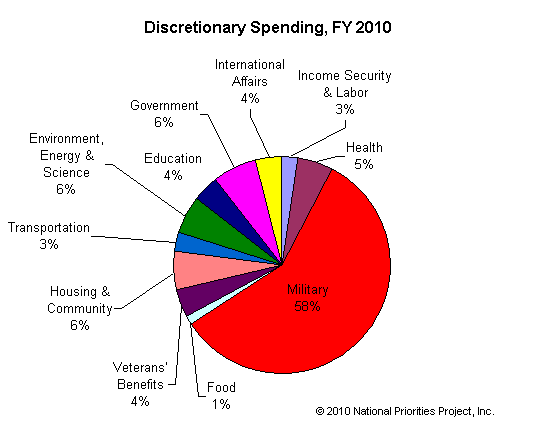
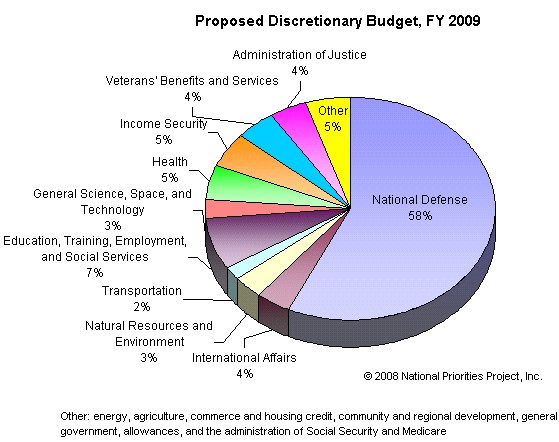
NPP describes these charts this way, explaining the difference between mandatory and discretionary spending: "[These charts show] the breakdown of the proposed federal discretionary budget for fiscal year 2010 [or 2009] by function area.
"The discretionary budget refers to the part of the federal budget proposed by the President, and debated and decided by Congress each year. The part of the budget constitutes more than one-third of total federal spending. The remainder of the federal budget is called mandatory spending. Fiscal Year 2009 will run from October 1, 2008 to September 30, 2009.
"Note that this chart includes the war-related spending requested by the administration as supplemental to the regular budget proposal."
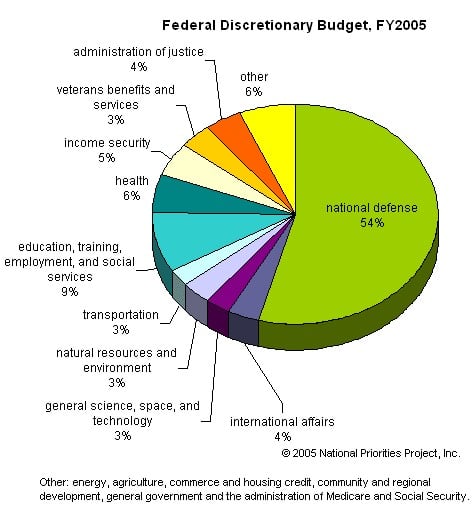
Note, too, per NPP: "Federal Discretionary and Mandatory Spending "Congress directly sets the level of spending on programs which are discretionary. Congress can choose to increase or decrease spending on any of those programs in a given year…. "About half of the discretionary budget is national defense, a government-defined function area that roughly corresponds in common parlance as military. However, this category does not include foreign military financing, security assistance, and other programs commonly thought of as military. Other types of discretionary spending include the budget for education, many health programs, and housing assistance.
"Mandatory spending includes programs, mostly entitlement programs, which are funded by eligibility rules or payment rules. Congress decides to create a program, for example, Food Stamps. It then determines who is eligible for the program and any other criteria it may want to lay out. How much is appropriated for the program each year is then determined by estimations of how many people will be eligible and apply for Food Stamps.
"Unlike discretionary spending, the Congress does not decide each year to increase or decrease the Food Stamp budget; instead, it periodically reviews the eligibility rules and may change them in order to exclude or include more people.
"Mandatory spending makes up about two-thirds of the total federal budget. By far the largest mandatory program is Social Security which makes up one-third of mandatory spending and continues to grow as the age demographic of the country shifts towards an older population. [See more at National Priorities Project.]
Also see discussion at How Are Our Federal Tax Dollars Spent? which shows that the military budget is one-fifth (21%) of our total budget:

But, which is the more realistic view of military spending? Which captures how Congress prioritizes spending? Which is more relevant to us? Arguably, discretionary spending is most relevant to ordinary citizens, as we continue to suffer under rising unemployment, increased foreclosures, bankster bailouts, million dollar industry bonuses while the minimum wage remains below poverty, all amid a global financial crisis. And what does that 58% of discretionary spending amount to? In 2010: $1,027.8 billion, or over a trillion dollars, according to Robert Higgs of the Independent Institute, at Defense Spending Is Much Greater than You Think: more than $1Trillion a year. |